Whole Health Creative Care
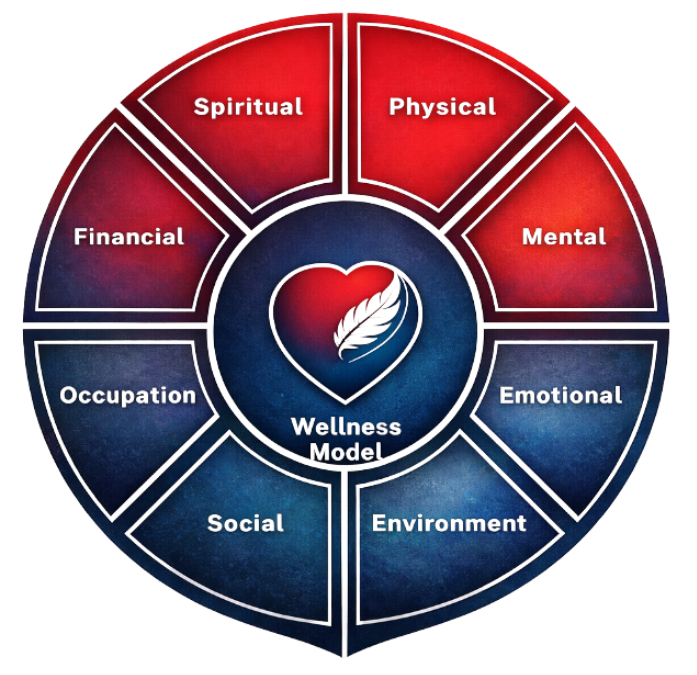
Overview: Wellness is not just about physical health. It’s a whole-life process. The wellness model on this page shows that well-being comes from finding balance across many areas. When one area is ignored, it often affects the others. But when all of these domains are supported together, people tend to feel more stable, connected, and capable. This approach is especially important for people in transition. It helps them rebuild not just one part of life, but their full sense of self.
Invitation: Creatively explore each domain of your wellness.
Tools Needed:
Sketchbook
Pencil
Markers
Air-dry clay (2 packs)
Introduction Activity
Design Your Sketchbook Cover
Who Are You?
(markers + pencil + sketchpad)
Design the cover of your sketchbook using your favorite colors, shapes, and symbols. Let this cover be a reflection of your identity, culture, energy, and even your current season of life. There is no right or wrong way to do this. Just let it be honest.
Reflection (5 minutes):
What stands out in what you created?
Does this feel complete, or still becoming?
Spiritual Domain
Page One of Sketchbook
What Gives Your Life Meaning?
(sketchpad + pencil or markers)
Spiritual doesn’t have to mean religion. It can simply mean what matters most to you. Take a moment to think about what gives your life a sense of meaning or purpose. This could be something you believe in, something you care about, or something that keeps you going.
Draw a symbol, shape, or simple image that represents that meaning.
It doesn’t need to be detailed—just honest.
Reflection (5 minutes):
What does this symbol represent to you?
Is this something you feel connected to right now, or something you want more of?
Mental Domain
Page Two of Sketchbook
What’s Taking Up Space?
(pencil)
On the first page, write down 3–5 things that have been on your mind lately.
Circle the one that feels most present or heavy.
Then draw a simple symbol or shape next to it.
Notice if giving it a shape changes how it feels.
Reflection (5 minutes):
Why does this one stand out right now?
Is it something you can act on, or something you need to release?
Emotional Domain
Page Three of Sketchbook
Color Without Words
(markers)
Fill a page using only color to represent how you feel right now.
No words—just color, pressure, and movement.
Let your hand move without overthinking.
If helpful, you can use color as a guide (or ignore it):
Red — intensity, anger, passion
Blue — calm, sadness, depth
Yellow — energy, hope, anxiety
Green — growth, balance, healing
Black — heaviness, protection, unknown
Purple — reflection, imagination, transition
You could also choose colors that don’t match this list at all—trust your own meaning.
Reflection (5 minutes):
What emotions showed up?
Did anything shift as you gave it form?
Physical Domain
Page Four of Sketchbook
Listening to the Body
(pencil or markers)
Draw a simple shape or outline that represents your body.
Use marks, colors, or symbols to show where you feel tension, energy, or calm.
Reflection (5 minutes):
What is your body asking for right now?
Rest, movement, care, attention?
There is no need to solve anything—just notice what’s there.
Social Domain
Page Five of Sketchbook
Connection
(sketchpad + markers)
Think of one relationship that matters to you.
Draw a symbol, line, or shape that represents that connection.
Then add or change something to show how you want it to grow.
Reflection (5 minutes):
What does this relationship need more of?
What role do you play in that?
Environmental Domain
Page Six of Sketchbook
Place and Grounding
(sketchpad + markers)
Go out in nature. Find a place where you feel grounded. Now draw or sketch something from that place.
Focus on feeling, not detail.
Reflection (5 minutes):
What about this place supports you?
How can you bring more of that into your daily life?
Occupational Domain
Page Seven of Sketchbook
Your Work in the World
(sketchpad + markers or pencil)
Think about how you spend your time, energy, and attention each day.
This could be your job, your role, or what you feel called toward.
Draw a symbol, shape, or simple image that represents how your work feels right now.
Then add or adjust something to show how you want it to feel.
Reflection (5 minutes):
Does your current work give you energy or take it away?
What would need to shift for it to feel more aligned?
Financial Domain
Page Eight of Sketchbook
Your Relationship with Resources
(sketchpad + pencil or markers)
Think about your relationship with money or resources.
Not just numbers—how it feels in your body and mind.
Draw a symbol or shape that represents that relationship.
Then gently change or add something to represent what you want it to become.
Reflection (5 minutes):
What feelings come up when you think about money or support?
What would a more supportive or stable relationship look like?
Transition
Page Nine of Sketchbook
What Matters Most?
(pause + optional writing)
Look back through everything you’ve created so far.
Notice what stands out, what repeats, or what feels most alive.
Reflection (5 minutes):
What feels most important right now?
What are you being invited to shift or pay attention to?
Shaping Vision
Air-dry Clay
Shape Your Future
(air-dry clay)
Part 1 — What You’re Carrying
Take one piece of clay.
Shape it into something that represents what you are carrying right now—a feeling, a burden, a responsibility, or something unnamed.
Part 2 — Creative Vision
Now reshape that same piece of clay into where you want to go.
Not perfect—just a direction. Let your hands guide you.
Reflection (5 minutes):
What changed as you reshaped it?
What does this new form represent for your future?
Closing
Take a moment to look at what you’ve created.
Notice what stands out.
Notice what shifted.
There is nothing you needed to do perfectly.
You showed up. That is enough.
If one thing feels important—carry that forward.
Creative vision is how futures begin.